A biography that leaves out criticism is not a biography. Each file below sets out what happened, the context, Steinmeier's documented position, the arguments of critics and supporters, and what followed. The language is deliberately neutral.
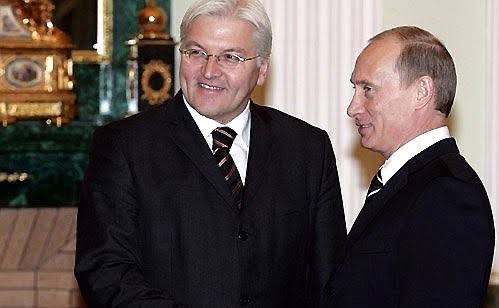
Plate 15With Vladimir Putin in the Kremlin during the 2000s. Germany's Russia policy is the most debated aspect of Steinmeier's career.
File 15.1 · Russia & energy2005 – 2022
Russia policy and Nord Stream 2
For many years Steinmeier was among the most prominent advocates of engagement with Russia, including economic interdependence through gas pipelines. Russia's invasion of Ukraine in 2022 made this record the most contested part of his career.
Context
The policy drew on the SPD tradition of Ostpolitik. As Foreign Minister he promoted a "partnership for modernisation" (2008); in 2008 Germany and France opposed a NATO Membership Action Plan for Ukraine and Georgia. Nord Stream 2 was supported by successive German governments.
His documented position
On 4 April 2022 he said: "My adherence to Nord Stream 2 was clearly a mistake. We held on to bridges that Russia no longer believed in and that our partners warned us about."
Critics
Critics in Ukraine, Poland, the Baltic states and in Germany argued that the policy deepened Europe's energy dependence, ignored repeated warnings and signalled to Moscow that aggression would carry limited cost.
Supporters
Defenders argued that dialogue was a broadly shared German and European policy, supported by chancellors of different parties, and that keeping channels open was legitimate in the circumstances of the time.
Subsequently
His April 2022 admission was unusual for a sitting head of state and was received both as a necessary act of candour and as a belated one. A planned visit to Kyiv that month did not take place; he visited Kyiv in October 2022.
File 15.2 · Guantánamo2002 – 2009
The Murat Kurnaz case
Murat Kurnaz, a Turkish citizen born and raised in Bremen, was detained by the United States at Guantánamo Bay from 2002 to 2006. Steinmeier, then head of the Federal Chancellery, faced accusations that the German government had failed to accept an opportunity to secure his release.
Context
The case was examined by a Bundestag committee of inquiry into the activities of the German intelligence services after 11 September 2001. Security agencies at the time regarded Kurnaz as a potential risk and sought to prevent his return to Germany.
His documented position
Steinmeier denied that there had been a formal US offer to release Kurnaz to Germany and defended the decisions taken on the basis of the security assessments available at the time.
Critics
Opposition politicians and human-rights advocates argued that Germany had prolonged the detention of a man who grew up in Bremen, and that security concerns had outweighed his fundamental rights.
Supporters
Coalition members argued that no release offer existed in a form that could have been accepted, and that the authorities had acted in good faith after the September 2001 attacks.
Subsequently
Kurnaz was released to Germany in 2006. The affair did not prevent Steinmeier's later career, but it remains a recurring point of criticism.
File 15.3 · Social policy2003 –
Agenda 2010 and the Hartz reforms
As Head of the Chancellery, Steinmeier coordinated the reform programme that restructured unemployment benefits and the labour market.
Critics
Trade unions and the SPD's left wing argued that the reforms increased insecurity, expanded low-wage work and broke with Social Democratic principles. The dispute contributed to the founding of a party to the left of the SPD and to lasting electoral losses.
Supporters
Supporters credit the reforms with contributing to the sharp fall in German unemployment in the following decade, a view shared by many economists, though the size of the effect is debated.
File 15.4 · Ukraine2015 – 2019
The "Steinmeier formula"
Steinmeier's proposal for implementing the Minsk agreements — holding local elections in the separatist-held Donbas under Ukrainian law and OSCE observation, after which a special status would take effect — became a political flashpoint in Ukraine.
Critics
When Ukraine's government signalled agreement to the formula in October 2019, protesters in Kyiv denounced it as a capitulation that risked legitimising Russian-controlled entities.
Supporters
Proponents saw it as a pragmatic sequencing device to unblock a stalled peace process, conditional on OSCE certification of free and fair elections.
File 15.5 · Statements2016 · 2019
Words that drew criticism
Three statements in particular provoked controversy.
NATO, June 2016
As Foreign Minister he warned against "saber-rattling" towards Russia during NATO exercises in Eastern Europe. Allies and German critics saw this as undermining Alliance solidarity; he argued for combining deterrence with dialogue.
Donald Trump, 2016
During the US election campaign he described Donald Trump as a "hate preacher". Critics regarded it as undiplomatic for a serving foreign minister; others saw it as a principled stand.
Iran telegram, February 2019
On the 40th anniversary of the Iranian revolution, the President's office sent a congratulatory telegram to Tehran. Josef Schuster, president of the Central Council of Jews in Germany, said that "routine diplomacy appears to have overtaken critical thinking"; other politicians also objected. The President's office replied that such greetings were longstanding state practice of the Federal Republic.
Assessments in this chapter are summarised from the public record and the reporting of established news organisations. Quotations are attributed to their speakers and dates as reported.