The Life
Politics
The Presidency
The World
Archive
EnquiryContact

Chapter 05 — Federal Foreign Minister

The diplomatic dossier

Steinmeier led the Federal Foreign Office twice, for a combined total of more than seven years. The two terms bracket a profound change in Europe's security environment — from the hopes of engagement with Russia to the annexation of Crimea.

Two files · 2005–2009 · 2013–2017

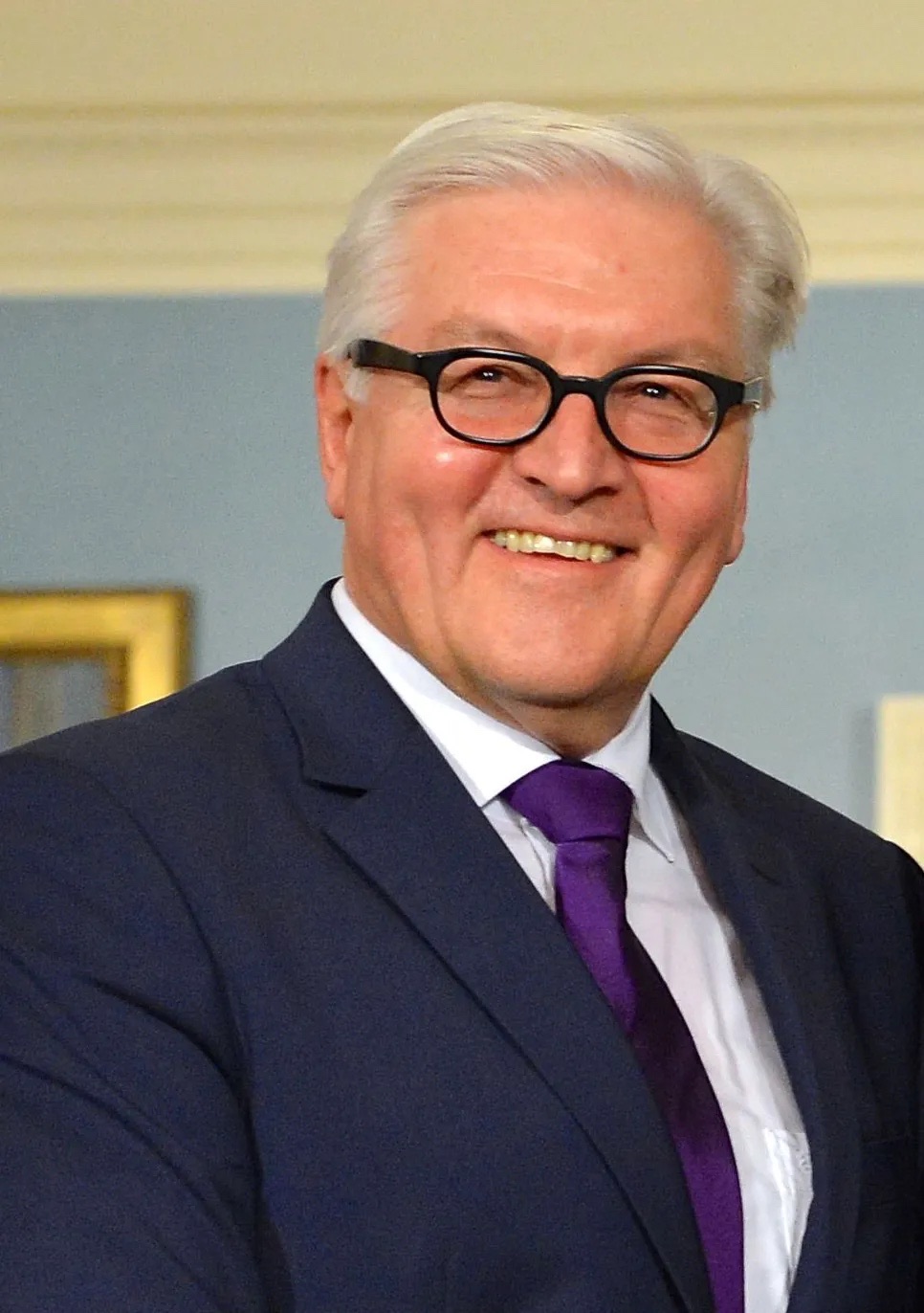
Frank-Walter Steinmeier smiling, wearing dark-rimmed glasses, a navy suit and a purple tie
Plate 05aFrank-Walter Steinmeier during his tenure as Federal Foreign Minister.
File A · First term22 Nov 2005 — 27 Oct 2009

Merkel I

Cabinet
First Merkel cabinet (CDU/CSU–SPD)
Predecessor
Joschka Fischer (Greens)
Successor
Guido Westerwelle (FDP)
Also
Vice-Chancellor from 21 November 2007

A.1Engagement with Russia

Steinmeier's first term was defined by the idea that deeper economic and societal ties would anchor Russia in Europe. In 2008 he promoted a "partnership for modernisation" with Moscow. At NATO's Bucharest summit in April 2008, Germany — with France — opposed granting Georgia and Ukraine a Membership Action Plan. Both positions were later central to criticism of German Russia policy.

A.2Europe and the Lisbon Treaty

Germany's 2007 presidency of the Council of the EU, conducted by Merkel and Steinmeier, prepared the ground for the Treaty of Lisbon after the failure of the European constitutional treaty.

A.3Crisis diplomacy

His office handled the August 2008 war between Russia and Georgia, efforts on the Iranian nuclear file within the E3+3 format, and the consular and political management of German hostage cases abroad.

A.4The 2009 campaign

As Vice-Chancellor he led the SPD's federal election campaign of 2009 while remaining Foreign Minister — the dual role of minister and challenger that the grand coalition imposed on both parties.
File B · Second term17 Dec 2013 — 27 Jan 2017

Merkel III

Cabinet
Third Merkel cabinet (CDU/CSU–SPD)
Predecessor
Guido Westerwelle (FDP)
Successor
Sigmar Gabriel (SPD)
Also
OSCE Chairperson-in-Office, 2016

B.1A more active Germany

At the Munich Security Conference on 1 February 2014 he argued that "Germany is too big merely to comment on world affairs from the sidelines" and warned that "a culture of restraint for Germany must not become a culture of standing aloof." With the Federal President Joachim Gauck and Defence Minister Ursula von der Leyen, he set out what became known as the "Munich consensus" on greater German responsibility. He followed it with the "Review 2014" consultation on the future of German foreign policy.

Source: Federal Foreign Office, speech of 1 February 2014

B.2Ukraine, Crimea and Minsk

On 21 February 2014, with Laurent Fabius of France and Radosław Sikorski of Poland, he mediated an agreement in Kyiv between President Viktor Yanukovych and the opposition. Yanukovych fled within hours; Russia then annexed Crimea and backed armed separatists in the Donbas. Germany and France pursued the "Normandy format" with Russia and Ukraine, which produced the Minsk II package of February 2015. Steinmeier's proposal for sequencing local elections and special status in the Donbas became known as the "Steinmeier formula".

B.3The Iran nuclear agreement

Germany was part of the E3/EU+3 group that concluded the Joint Comprehensive Plan of Action with Iran in Vienna on 14 July 2015, limiting Iran's nuclear programme in exchange for sanctions relief.

B.4Syria and the Vienna talks

He was among the initiators of the Vienna talks of October and November 2015, which brought together the International Syria Support Group, including Russia, Iran and Saudi Arabia, in search of a political process for Syria.

B.5OSCE chairmanship 2016

Germany chaired the Organization for Security and Co-operation in Europe in 2016, with Steinmeier as Chairperson-in-Office, under the motto of renewing dialogue, rebuilding trust and restoring security.

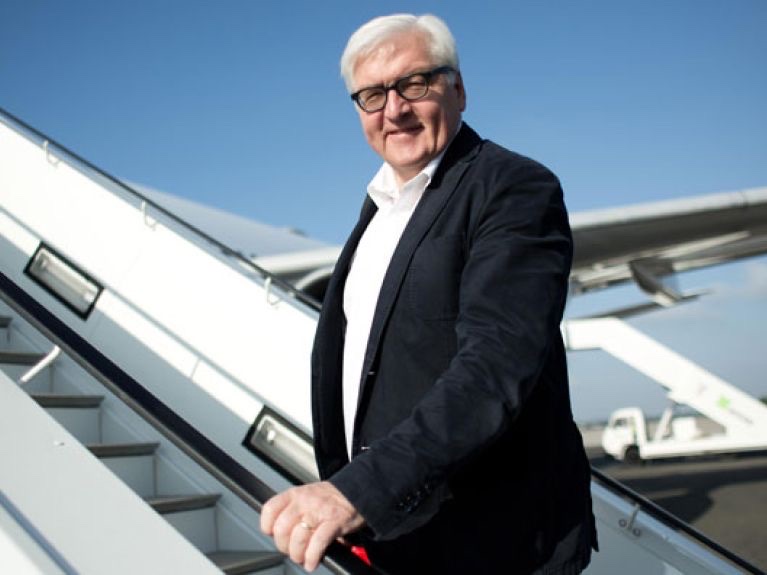
Frank-Walter Steinmeier smiling as he climbs the steps of an aircraft on a sunny day
Plate 05bBoarding a government aircraft — the Foreign Minister's travel schedule was among the most intensive in the cabinet.

Assessment

Method and its limits

Steinmeier was a popular Foreign Minister at home, frequently among the most positively rated politicians in German opinion surveys. Supporters credited him with keeping channels to Moscow open at moments when escalation seemed possible, and with the patient diplomacy that produced the Iran agreement.

Critics, particularly after 2022, argue that the same approach underestimated the Kremlin's intentions and gave insufficient weight to the warnings of Germany's Central and Eastern European partners. Steinmeier himself conceded in April 2022 that Germany had "held on to bridges that Russia no longer believed in". See the controversies file.