Across four decades, Steinmeier has treated European integration as the frame within which German power becomes legitimate — and the answer to the question of how a reunified Germany at the centre of the continent should conduct itself.
Germany in Europe
A partner, not a hegemon
Steinmeier's European thinking starts from Germany's history and size. A country of more than eighty million people at the heart of the continent, he has argued, can only exercise influence acceptably through shared institutions. This is why his diplomacy has repeatedly sought formats that bind Germany to its neighbours — the Franco-German tandem, the Weimar Triangle with France and Poland, and the EU's common foreign policy.
Europe in Germany
A democratic promise at home
As President he has presented the European Union as a guarantee of peace and of the democratic order established after 1945 and 1989. His speeches link Europe to the Basic Law, to reunification and to the rejection of nationalism — the "temptations of a new brand of nationalism" from which, he said on 8 May 2020, Germans must liberate themselves.
Formats
The architecture he worked through
The Weimar Triangle
The trilateral format of Germany, France and Poland was put to dramatic use on 20–21 February 2014, when Steinmeier, Laurent Fabius and Radosław Sikorski travelled to Kyiv together to mediate between President Yanukovych and the Maidan opposition.
The Franco-German core
With France he co-led the Normandy format on Ukraine. After the British referendum on EU membership in June 2016 he and French Foreign Minister Jean-Marc Ayrault presented a joint paper on the future of a stronger Europe.
The founding six
Immediately after the Brexit vote, on 25 June 2016, he hosted the foreign ministers of the six founding members of the European Communities in Berlin to discuss the consequences for the Union.
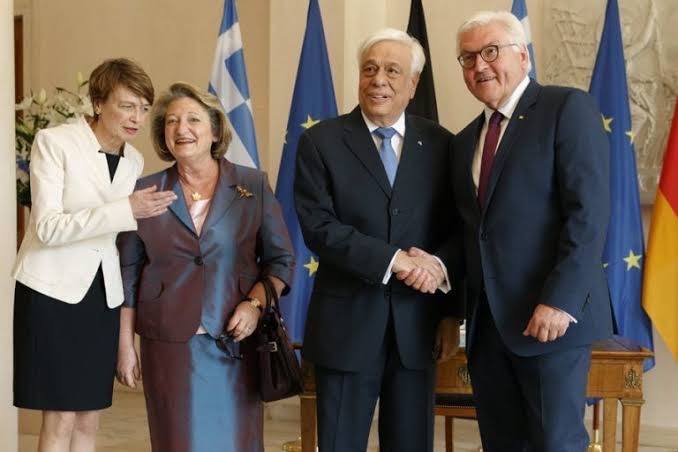
Plate 09With Greek President Prokopis Pavlopoulos during a visit to Greece; Elke Büdenbender stands at far left.
Neighbours and memory
Reconciliation as European policy
For Steinmeier, European unity and historical responsibility are inseparable. Some of his most significant presidential appearances have been in neighbouring countries occupied by Germany during the Second World War.
In Poland he marked the 80th anniversary of the German invasion in Wieluń and Warsaw on 1 September 2019, became the first German head of state to speak at the commemoration of the Warsaw Ghetto Uprising on 19 April 2023, and on the eve of the 80th anniversary of the 1944 Warsaw Uprising again asked Poles for forgiveness. Relations with Greece, Italy and others have been accompanied by similar acts of remembrance.
Critics in Poland and elsewhere have argued that such gestures should be accompanied by more concrete steps, including the long-running debate about reparations, which the German government regards as legally settled.
Europe at war
After 24 February 2022
Russia's full-scale invasion of Ukraine forced a re-examination of the European security assumptions that had shaped Steinmeier's career. He has since described the invasion as an epochal break, supported Ukraine's path towards the European Union, and called on Germans to accept the costs of solidarity.
On 8 May 2025 he spoke of a "double break with history": Russia's war of aggression, and a United States turning away from the international order it had helped to build — "a shock of a completely new scale". His answer was more Europe: a Union able to defend its own security.
Quotations: Federal President, speech in the German Bundestag, 8 May 2025 (English translation as reported).