The Life
Politics
The Presidency
The World
Archive
EnquiryContact

Chapter 06 — The Presidency

Schloss
Bellevue

First term · 19 March 2017 – 18 March 2022Second term · from 19 March 2022Twelfth Federal President
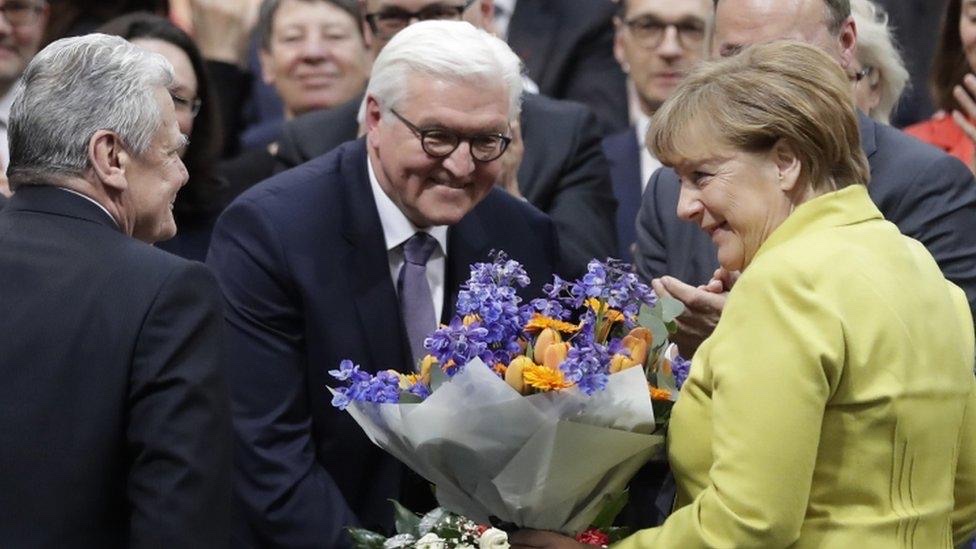
Frank-Walter Steinmeier, smiling, receives flowers from Chancellor Angela Merkel while outgoing President Joachim Gauck looks on, in the Bundestag chamber
Plate 0612 February 2017: after his election by the Federal Convention, Steinmeier receives flowers from Chancellor Angela Merkel; his predecessor Joachim Gauck stands at left.

Two elections

Chosen by the Federal Convention

The Federal President is not elected by popular vote but by the Federal Convention (Bundesversammlung), composed of all members of the Bundestag and an equal number of delegates chosen by the state parliaments. Steinmeier was nominated in 2016 as the joint candidate of the governing CDU/CSU and SPD and elected in the first ballot.

In 2022 he was supported for a second term by the SPD, CDU/CSU, Greens and FDP. He became the first Social Democratic President to be re-elected.

16th Federal Convention · 12 February 2017931 of 1,239 valid votes · 75.1 %
17th Federal Convention · 13 February 20221,045 votes · approx. 78 % of votes cast

Share in 2017 calculated on valid votes. Source: German Bundestag records of the Federal Conventions.

Institutional timeline

The presidency, year by year

201719 March · Oath of office

Taking office — and a coalition crisis

Sworn in before the Bundestag and Bundesrat on 22 March 2017, Steinmeier soon faced the first test of his office. When talks on a "Jamaica" coalition of CDU/CSU, FDP and Greens collapsed in November 2017, he met party leaders and reminded them of their responsibility to form a government. The SPD, which had ruled out a renewed grand coalition, entered talks; Angela Merkel was re-elected Chancellor on 14 March 2018.

2018Remembrance & reach

A presidency of remembrance

He marked the centenary of the end of the First World War and of the proclamation of the German republic in November 2018, and undertook a state visit to India from 21 to 26 March 2018. Remembrance of German history, including its democratic traditions, became a defining theme.

20191 September · Poland

80 years since the invasion of Poland

In Wieluń and Warsaw he commemorated the German invasion of Poland in 1939 and asked for forgiveness. In February 2019 he was criticised for a congratulatory telegram to Iran on the anniversary of its revolution. See controversies.

2020The pandemic year

Yad Vashem, 8 May and COVID-19

On 23 January he spoke at the World Holocaust Forum at Yad Vashem. On 11 April he gave a televised address on the coronavirus pandemic, and on 8 May he marked the 75th anniversary of the end of the war. In the autumn he withheld his signature from a law against hate crime pending constitutional corrections.

202118 April · Commemoration

Mourning the pandemic dead

He initiated a national commemoration for the victims of the COVID-19 pandemic in April 2021. In October he joined the Presidents of Ukraine and Israel in Kyiv to mark the 80th anniversary of the Babyn Yar massacre.

202224 February · Epochal break

Re-election and war

Re-elected on 13 February, he condemned Russia's full-scale invasion of Ukraine eleven days later. On 4 April he acknowledged that his adherence to Nord Stream 2 had been a mistake. A planned April visit to Kyiv did not take place; he travelled to Kyiv on 25 October 2022. On 28 October he addressed the nation, warning that "harder years, rough years" lay ahead.

2023Warsaw · Songea

Forgiveness asked, twice

He hosted King Charles III on his first state visit as monarch (29–31 March), became the first German head of state to speak at the commemoration of the Warsaw Ghetto Uprising (19 April), and on 1 November in Songea, Tanzania, asked forgiveness for German colonial crimes during the Maji Maji war.

202427 December · Dissolution

Seventy-five years of the Basic Law

He published the essay "Wir" in April for the anniversary of the Basic Law, conferred the Grand Cross special class of the Order of Merit on President Joe Biden on 18 October, and — after the collapse of the Scholz coalition and a lost confidence vote — dissolved the Bundestag on 27 December, setting new elections for 23 February 2025.

20256 May · New Chancellor

A new government

After the February election he appointed Friedrich Merz Chancellor on 6 May 2025, following the first second-round chancellor vote in the Federal Republic's history. On 8 May he addressed the Bundestag on the 80th anniversary of the end of the Second World War.

2026Final full year

Security and partnership

In May 2026 he visited Sweden and Finland, focusing on crisis preparedness on NATO's northern flank, and in June 2026 became the first German head of state to visit the Philippines since 1963.

202730 January · Convention

Succession

The Basic Law permits only one immediate re-election. The 18th Federal Convention to elect his successor has been scheduled for 30 January 2027; his term ends in March 2027.

Domestic role

Speaking for the whole country

Steinmeier's domestic presidency has concentrated on cohesion: the relationship between eastern and western Germany, the dignity of democratic politics against hostility and threats to local officials, and public service. In 2022 he opened a debate on a compulsory period of social service for young people. He has travelled extensively through smaller towns with a format of extended local visits, intended to listen beyond the capital.

The constitutional powers   The speeches