The Life
Politics
The Presidency
The World
Archive
EnquiryContact

Chapter 13 — Major Positions & Policies

Documented convictions

The positions below are drawn from Steinmeier's public record — speeches, statements and official acts. Where his views have changed, the change is recorded. As Federal President he is expected to stand above party politics; most entries therefore concern the constitutional order, history and Germany's place in the world rather than day-to-day policy.

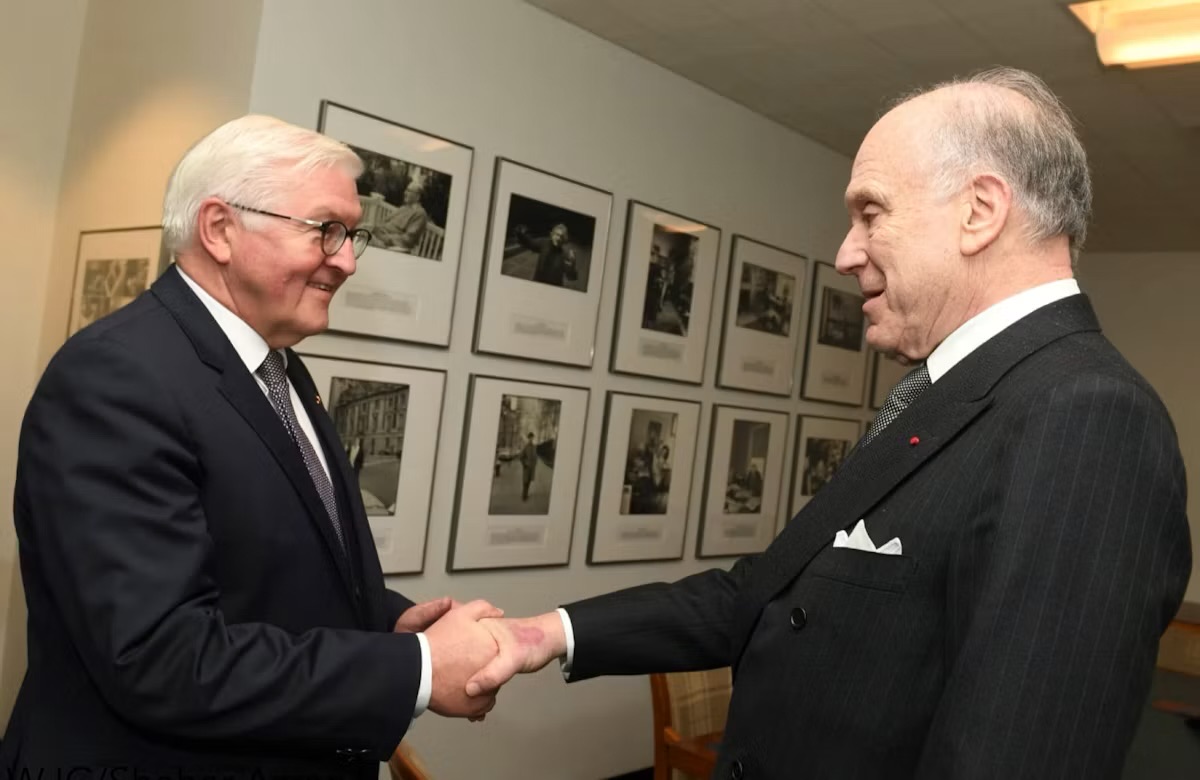
Frank-Walter Steinmeier shakes hands with Ronald S. Lauder in a room lined with framed black-and-white photographs
Plate 13With Ronald S. Lauder, President of the World Jewish Congress.

Democracy must be defended, not assumed

The central theme of his presidency. He has repeatedly warned against hostility towards democratic institutions, threats against local politicians and the normalisation of extremist rhetoric. "We have already lost democracy once in Germany," he told the Bundestag on 8 May 2025.

Related: his 2024 essay "Wir", published for the 75th anniversary of the Basic Law, on the shared foundations of German democracy.

Remembrance has no end point

For Steinmeier the memory of the Holocaust and of German crimes in the Second World War is an enduring obligation. "For us Germans, responsibility for our history has no end point," he said in Warsaw in April 2023.

He has extended this to lesser-known chapters: the German war of annihilation in Eastern Europe, the massacre at Babyn Yar, the destruction of Koriukivka and German colonial violence in Africa.

Antisemitism is an attack on the Republic

At Yad Vashem in 2020 he warned that "the spirits of evil are emerging in a new guise." He has described the protection of Jewish life in Germany and the security of Israel as permanent responsibilities of the German state.

Critics have pointed to the 2019 telegram to Iran as at odds with this stance. See case file.

Russia: from engagement to an admission of error

For most of his career he advocated dialogue and economic interdependence with Russia, including the 2008 "partnership for modernisation" and, later, support for Nord Stream 2.

After the invasion of Ukraine he revised that position publicly, calling his adherence to Nord Stream 2 "clearly a mistake", and has since supported Ukraine's defence and condemned Russia's distortion of history.

Europe as Germany's frame

He considers European integration the basis of German security and prosperity, and the reconciliation with France and Poland its moral foundation. In 2025 he argued that Europe must become more capable of defending itself.

Germany & Europe

Confronting the colonial past

In Songea, Tanzania, on 1 November 2023, he asked forgiveness for the crimes of German colonial troops in the Maji Maji war and committed himself to greater awareness of colonial history in Germany.

His approach — acknowledgement, apology and dialogue with descendants — has been welcomed by many but criticised by some for leaving the question of reparations open.

Service to the community

In June 2022 he called for a debate on a compulsory period of social service for young people — a "social duty period" — arguing that it could strengthen cohesion between generations and social groups.

The proposal drew both support and criticism, including from youth organisations objecting to compulsion; it remained a matter of public debate rather than legislation.

Multilateralism and diplomacy

From his years as Foreign Minister he has argued for diplomatic engagement, arms control and international institutions, and for Germany to accept greater international responsibility, as he put it in Munich in 2014.

Foreign policy & diplomacy