The Maidan agreement
With his French and Polish counterparts, Foreign Minister Steinmeier mediated an agreement between President Yanukovych and the opposition, overtaken within hours by Yanukovych's flight.
Twelfth Federal President of Germany
A jurist from rural Lippe who became one of the defining administrators of modern German government — Head of the Federal Chancellery, twice Federal Foreign Minister, Vice-Chancellor and, since 19 March 2017, Federal President.
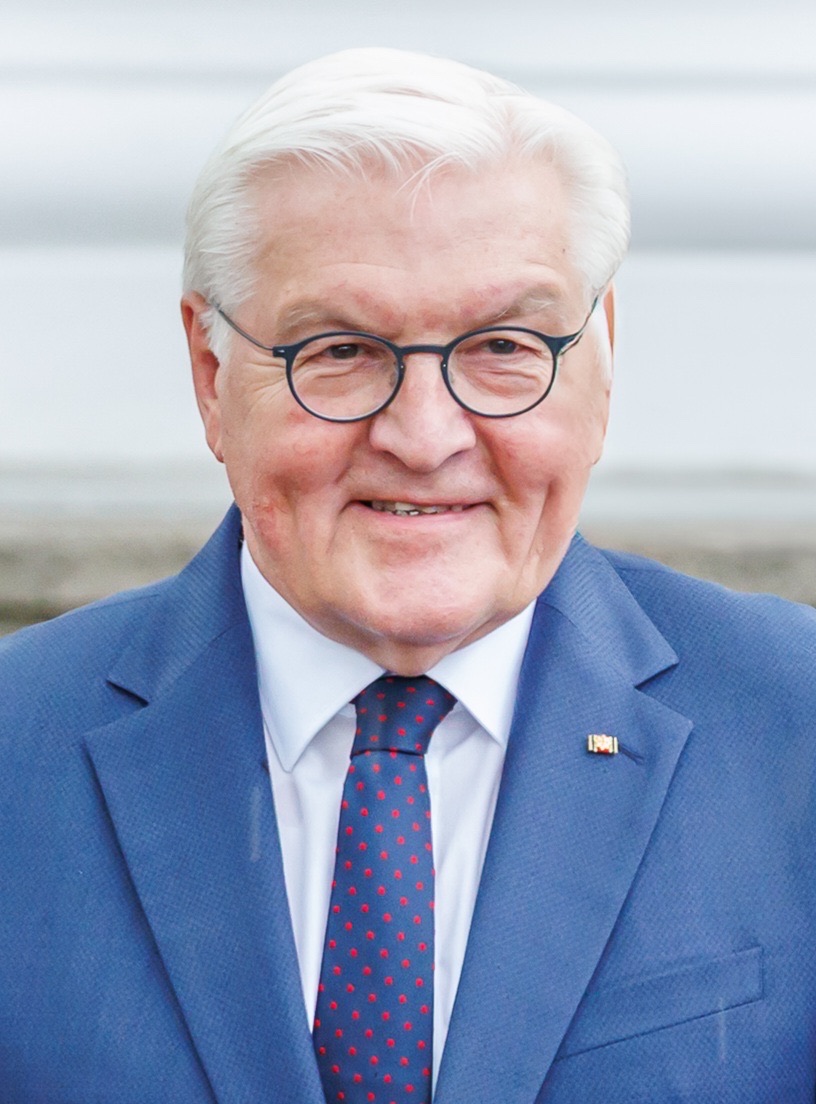
Federal President of the Federal Republic of Germany, the first Social Democrat in the office to be re-elected.
Votes of 1,239 valid ballots at the Federal Convention of 12 February 2017.
Votes — about 78 per cent — on his re-election by the Federal Convention on 13 February 2022.
Federal Foreign Minister, in Angela Merkel's first (2005–09) and third (2013–17) cabinets.
Introduction
Few figures have been present at as many turning points of the Federal Republic as Frank-Walter Steinmeier. As Gerhard Schröder's chief of staff he coordinated the Agenda 2010 reforms that reshaped Germany's labour market and welfare state. As Foreign Minister he negotiated with Moscow, Tehran and Kyiv in a decade that tested the post-Cold-War order. As Federal President he has spoken for the country through a pandemic, the return of war to Europe, the collapse of a coalition and the reckoning with Germany's twentieth-century crimes.
His public persona is that of the administrator-diplomat: methodical, legalistic, committed to dialogue. That same disposition is the source of the most serious criticism of his career — that Germany's engagement with Vladimir Putin's Russia, which he championed for years, rested on illusions. Steinmeier himself acknowledged in April 2022 that holding on to Nord Stream 2 had been "clearly a mistake".
This archive sets out the record: the offices, the decisions, the speeches and the controversies, with dates, context and attributed quotations. It is written to inform rather than to advocate.
The chapters
Born in Detmold in 1956 to a carpenter and a mother who had fled Silesia, he grew up in the village of Brakelsiek, took his Abitur in Blomberg and studied law and political science at Giessen.
Early lifeFrom the Lower Saxony State Chancellery in 1991 to the Federal Chancellery in 1998, the chancellor candidacy of 2009 and four years as leader of the SPD parliamentary group.
Political journeyTwo terms at the Federal Foreign Office: the Russia "partnership for modernisation", the Ukraine crisis, Minsk, the Iran nuclear agreement and Germany's 2016 OSCE chairmanship.
The dossierElected in 2017 and re-elected in 2022, he has overseen two difficult government formations and dissolved the Bundestag after the 2024 coalition collapse.
The presidencyA consistent advocate of European integration and of the Franco-German and German-Polish partnerships, he treats Europe as the frame of German interest rather than an alternative to it.
Germany & EuropeA diplomacy of dialogue and crisis prevention, tested by Russia's annexation of Crimea and transformed by the full-scale invasion of Ukraine in 2022.
Foreign policyMajor historical moments
With his French and Polish counterparts, Foreign Minister Steinmeier mediated an agreement between President Yanukovych and the opposition, overtaken within hours by Yanukovych's flight.
Germany, as part of the E3/EU+3 group, concluded the Joint Comprehensive Plan of Action with Iran after years of negotiation.
Weeks after Russia's full-scale invasion of Ukraine, the President conceded that his long support for Nord Stream 2 had been a mistake.
After Chancellor Scholz lost a vote of confidence, the President dissolved parliament and set the snap election for 23 February 2025.
Speeches and public statements
I wish I could say that we Germans have learnt from history once and for all. But I cannot say that when hatred is spreading.
Frank-Walter Steinmeier · World Holocaust Forum, Yad Vashem, Jerusalem · 23 January 2020 · Source: bundespraesident.de
Leadership philosophy — in his own documented words
Germany is too big merely to comment on world affairs from the sidelines.
For us Germans, responsibility for our history has no end point.
In 1945 we were liberated. Today, we must liberate ourselves.
Legacy
Steinmeier's second and final term ends in March 2027; the Federal Convention to elect his successor has been scheduled for 30 January 2027. Assessments of his career divide along a clear line. Admirers point to the craftsmanship of Agenda 2010, a diplomacy that kept channels open in moments of acute danger, and a presidency that made remembrance, democratic resilience and civic cohesion its central themes.
Critics — in Germany, in Ukraine, in Poland and the Baltic states — argue that the Russia policy he shaped as chief of staff and Foreign Minister contributed to European energy dependence and misjudged Moscow's intentions. Both views are documented here.