Berlin editionTwo decades at the centre of German policy2003 — 2025
Ukraine · 24 February 2022
War returns to Europe — and a President revises his record
Russia's full-scale invasion of Ukraine turned the central premise of Steinmeier's Russia policy on its head.
On 24 February 2022, eleven days after his re-election, Russian forces invaded Ukraine. Steinmeier condemned the attack and, on 4 April 2022, gave an unusually personal account of his own record: "My adherence to Nord Stream 2 was clearly a mistake. We held on to bridges that Russia no longer believed in and that our partners warned us about."
A planned trip to Kyiv in April 2022, alongside the presidents of Poland and the Baltic states, did not take place; Steinmeier said that his visit had evidently not been wanted in Kyiv. The episode, widely reported as a snub, reflected anger in Ukraine over his earlier policy. He travelled to Kyiv on 25 October 2022 and spent time in a shelter in Koriukivka during an air-raid alert. Three days later, in an address on 28 October, he told Germans that "harder years, rough years" lay ahead.
Sources: statement of 4 April 2022 as reported by international news agencies; speech of 28 October 2022 (translated from German: "Es kommen härtere Jahre, raue Jahre auf uns zu").
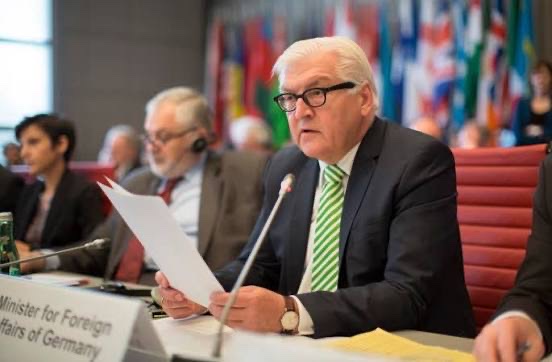
Plate 11At a multilateral session as Federal Foreign Minister.Kyiv · 21 February 2014
Mediation on the Maidan
After deadly violence in central Kyiv, Steinmeier, Laurent Fabius and Radosław Sikorski brokered an agreement between President Viktor Yanukovych and opposition leaders providing for early elections and constitutional reform. Within hours Yanukovych left the capital; Russia then moved to annex Crimea.
Berlin · 14 March 2003
Agenda 2010
Chancellor Schröder announced a sweeping reform of the labour market and welfare state in the Bundestag. As Head of the Chancellery, Steinmeier coordinated the programme. Its Hartz reforms remain among the most debated policies in modern German history.
Minsk · 12 February 2015
Minsk II
In the Normandy format, the leaders of Germany, France, Russia and Ukraine agreed a package of measures for the Donbas. Steinmeier's later "formula" on sequencing elections and special status became a contested element of its implementation.
Vienna · 14 July 2015
The Iran agreement
The Joint Comprehensive Plan of Action was concluded between Iran and the E3/EU+3, including Germany. Steinmeier defended it as a triumph of diplomacy; the United States withdrew in 2018.
Berlin · 12 February 2017
Elected Federal President
The 16th Federal Convention elected Steinmeier with 931 of 1,239 valid votes. Nine months later, after "Jamaica" coalition talks collapsed in November 2017, he pressed the parties — including his own SPD — to reconsider their responsibility; a new grand coalition took office in March 2018.
Germany · 2020 – 2021
The pandemic presidency
In a televised address on 11 April 2020 he spoke to the nation about the coronavirus pandemic. On 18 April 2021 he led a national commemoration for those who had died of COVID-19 — an act of collective mourning for which there had been no established form.
Jerusalem · 23 January 2020
Yad Vashem
At the World Holocaust Forum he warned that he could not say Germans had learnt from history once and for all "when hatred is spreading". Speech archive
Warsaw · 19 April 2023
The Ghetto Uprising
The first German head of state to speak at the commemoration, he asked for forgiveness "for the crimes committed by Germans here."
Berlin · 27 December 2024
Parliament dissolved
After the collapse of the Scholz coalition and a lost confidence vote, he dissolved the Bundestag. The election of 23 February 2025 led to Friedrich Merz's election as Chancellor on 6 May 2025. Constitutional role